If a practice is behind on blood-pressure control, the usual measures say so without suggesting what to do next. Prevalence, case mix and deprivation explain a good deal of the variation between practices, and none of them is something a practice can act on directly.
So I wanted to know whether anything in a practice’s own routinely published prescribing data points towards a group of patients worth reviewing. Not a verdict on anyone’s prescribing, but somewhere to start looking. I tested one candidate: upper-strength calcium-channel blocker (CCB) items relative to ACE inhibitor and angiotensin-receptor blocker (ACEi/ARB) items.
The reason for choosing that one is that there is good randomised evidence behind combination therapy. Pooled across 42 factorial trials, it shows that adding a medicine from a different class lowers blood pressure roughly five times as much as doubling the dose of the one already prescribed. The 2024 ESC guidelines take that a step further and build it into the shape of treatment, recommending that most adults start on a two-drug combination rather than a single medicine escalated by dose.
So optimising this particular pairing is not a fringe idea; it is what the trial evidence and European guidance both point at. A practice that consistently leans the other way would, in aggregate, accumulate upper-strength CCB items without the matching ACEi/ARB items. Whether that pattern shows up in national data, and whether it tracks with blood-pressure control at all, is the question this analysis set out to answer.
The short answer
A higher upper-strength CCB to ACEi/ARB ratio was associated with slightly poorer blood-pressure target attainment, in two separate adjusted national cross-sections. The association was small and consistent. A second prescribing-mix ratio I expected to behave the same way did not, which is a genuine complication rather than a footnote. The design is ecological, so it cannot establish cause. The measure earns its place as a conditional prompt for review.
01
What the ratio measures
It counts a practice’s dispensed items for the top strengths of the common calcium-channel blockers, amlodipine 10 mg, felodipine 10 mg and lercanidipine 20 mg, and compares that with how many ACE inhibitor and ARB items the same practice dispensed over the year. Datim-QI shows it as upper-strength CCB items per 100 ACEi/ARB items, with both item counts on the card, so you can always see what the ratio is actually made of.
What “high dose” does and does not mean here
It is a formulation-strength proxy, nothing more. OpenPrescribing does not reveal prescribed daily dose, indication, adherence, age, disease, or which medicines belong to the same person. Nifedipine and non-dihydropyridine CCBs were excluded because presentation strength is a particularly poor proxy for daily antihypertensive dose in those groups. OpenPrescribing sets out these limitations in its data FAQ.
Most importantly, a practice-level ratio is not a measure of combination therapy. The CCB items and the ACEi/ARB items may belong to entirely different patients. Nothing in this data source can tell you what any individual is taking.
02
What the analysis found
I linked 12-month OpenPrescribing windows with CVDPREVENT practice data at March 2024 and December 2025. The outcome was the percentage of people with recorded hypertension whose measured blood pressure met the age-appropriate threshold. CVDPREVENT is a national audit built from rolling extracts of routinely recorded general-practice data; NHS England describes the collection and its limitations on the CVDPREVENT dataset page.
Weighted models adjusted for age structure, neighbourhood-weighted ethnicity, deprivation, QOF hypertension, diabetes and CKD prevalence, 42 ICB fixed effects, and prescribing intensity within the CCB and ACEi/ARB pair. A one-standard-deviation higher log ratio was associated with 0.57 percentage points lower blood-pressure control in 2024, and 0.66 points lower in 2025. Substituting combined pair items per 1,000 patients for the primary intensity term produced very similar estimates.
The adjustment was built up in stages, which is the more informative way to read it. Starting from age and ethnicity alone the estimate was 0.50 percentage points, and adding deprivation, disease prevalence, ICB fixed effects and prescribing intensity in turn left it at 0.57. An association driven by the case mix a practice serves should fade as those controls go in. This one did not.
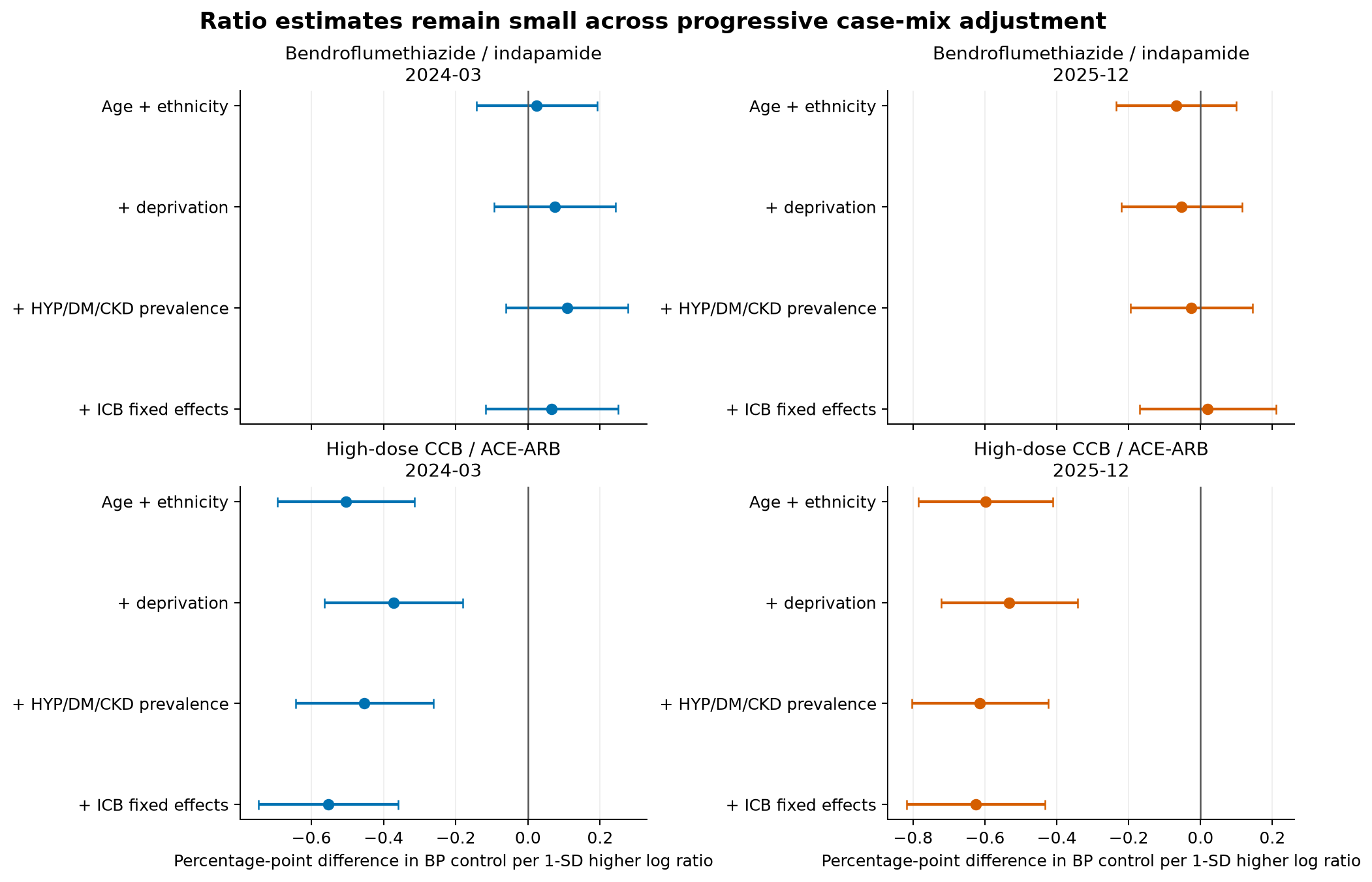
A second ratio was tested alongside it, and this is where the story gets more complicated than a single result. NICE NG136 prefers a thiazide-like diuretic such as indapamide over bendroflumethiazide, so a practice with a high bendroflumethiazide to indapamide ratio is guideline-discordant in the same broad sense. I expected it to track with poorer control too. It did not. The estimate was close to null after equivalent adjustment in both snapshots.
What the two results suggest about priority
The more useful reading is about priority. Indapamide has better outcome-trial evidence behind it than bendroflumethiazide, and that remains a good reason to prefer it. But the choice between those two diuretics does not appear to move measured blood-pressure control at practice level, whereas the balance between upper-strength CCB and ACEi/ARB prescribing does, at least a little. If a practice is deciding where to spend a limited amount of attention on hypertension prescribing, these results point at the CCB and ACEi/ARB question first, and the diuretic switch as a slower piece of work justified on outcomes rather than on blood pressure.
03
The decision point comes earlier than the ratio does
The ratio is a rear-view mirror. By the time a practice appears at the high end of it, a series of individual decisions to increase a CCB dose has already been taken, one appointment at a time, each of them entirely reasonable in isolation. The clinically useful moment sits earlier, and it is worth stating plainly because it is where the actual choice lives:
Someone’s blood pressure is above target on a standard-dose CCB. What now?
This is the fork in the road. One path increases the amlodipine from 5 mg to 10 mg. The other adds a medicine from a complementary class. Both feel like “doing something” in the consultation, and they are not equivalent.
Evidence from 42 factorial trials involving 10,968 participants found that adding a medicine from a different class produced roughly five times the additional blood-pressure reduction achieved by doubling the dose of a single medicine. Dose-related adverse effects move the other way: CCB ankle oedema increases with dose, and adding renin-angiotensin-system blockade reduces it, while uptitrating the CCB does not.
The uncontrolled-on-low-dose consultation is therefore worth naming explicitly, because it is entirely invisible to this metric. The upper-strength ratio only detects the aggregate residue of that decision having already gone the other way, repeatedly, over a long period. A practice acting on this analysis should not confine itself to the patients the metric happens to point at.
That is an argument for widening the review, not for redirecting it. For someone already at the top dose, adding a complementary class carries a second and quite specific benefit: it addresses the dose-related ankle oedema that the higher strength may itself be causing, which the next section covers, and which is a common reason people quietly stop taking a CCB at all. Reviewing that group can improve blood pressure and tolerability in the same conversation. Both groups are worth the time, for different reasons.
Which complementary class to add is not a choice a dataset can make. It turns on kidney function, potassium, pregnancy potential, previous angioedema, postural symptoms, frailty, comorbidity, the indication for the original prescription, and the person’s own preference. See NICE NG136 recommendations.
04
Why the clinical question is reasonable
The factorial meta-analysis above is the clearest statement of the dose-versus-class trade-off: read the meta-analysis on PubMed. It supports asking the review question. It does not identify which second class is right for any individual, and it was not designed to.
On tolerability, NHS Specialist Pharmacy Service notes that ACE inhibitors and ARBs can reduce the incidence of CCB-related ankle oedema in some patients, while diuretics have little effect on that particular mechanism. A meta-analysis of 25 randomised trials reported 38% less peripheral oedema with a CCB plus renin-angiotensin-system blockade than with CCB monotherapy. See the SPS review and the trial meta-analysis. This matters for the low-dose decision too: oedema is a common reason people quietly stop taking a CCB, and an uptitration that is never actually swallowed lowers nobody’s blood pressure.
05
How this fits with wider research and ESC guidance
The trial evidence on dose versus class is reasonably consistent, and it points one way: combining classes at lower doses achieves more blood-pressure reduction, with fewer dose-dependent adverse effects, than pushing a single medicine towards its ceiling.
The 2024 ESC guidelines for elevated blood pressure and hypertension build that directly into the structure of treatment. For most adults they recommend starting with a two-drug combination, ideally as a single pill, typically a renin-angiotensin-system blocker together with a CCB or a thiazide or thiazide-like diuretic, rather than monotherapy escalated by dose. The stated reasoning is the one this article keeps returning to: faster control, better tolerability than high-dose monotherapy, and better adherence from single-pill combinations. See the ESC guideline page.
NICE NG136 retains a stepped approach that begins with monotherapy and adds at step 2, so UK practice is organised differently. That difference is the reason a metric like this one has anything to detect at all. Under a combination-first structure, the choice between adding a class and increasing a dose largely does not arise. Under a stepped structure it arises constantly, in individual consultations, and the aggregate of those decisions is visible in dispensing data.
Where this analysis sits
It does not replace the randomised evidence, and it is not trying to. What it adds is something trials are not designed to do: it shows that the pattern is visible at national scale in routine NHS data, in two independent cross-sections twenty-one months apart, covering about 6,000 practices each. Replication across separate data vintages is the thing observational work is usually criticised for lacking.
It also held up under adjustment rather than dissolving under it. Adding deprivation, disease prevalence, 42 ICB fixed effects and prescribing intensity in sequence left the estimate where it started, and the fully adjusted figure was slightly larger than the minimally adjusted one. Confounding usually pulls an association towards zero as controls are added. This one did not move that way.
And “small” deserves context. England’s hypertension register holds about 9.4 million people, so 0.66 percentage points of blood-pressure control is on the order of 60,000 patients. That is not a large effect for any individual practice, and it is a real number of people nationally.
06
How Datim-QI uses the signal
Datim-QI shows the ratio on a practice’s prescribing page alongside its ICB and England comparators, with both underlying item counts, in the same format as every other prescribing measure. That much is simply description, and it is available whether or not anything else is true.
It becomes a suggested review only when two conditions hold together. The first does the selecting: an earlier version compared the ratio with the England average, which splits the country roughly in half and therefore selected nothing, so it is now the highest quartile.
Prescribing mix
Is the practice’s upper-strength CCB to ACEi/ARB ratio in the highest quartile in England?
Outcome gap
Is CVDPREVENT blood-pressure control below England, or below a published ambition for the same all-age outcome?
Clinician review
Only when both are true, review people with confirmed above-target blood pressure and an open next step.
The second condition is deliberately generous. Almost every practice in England misses the 85% ambition for this outcome, so it works as a floor rather than a filter: it excludes practices that already meet the highest published ambition, and passes the rest through to the quartile test. That is the intended behaviour. A practice at 72% is already ahead of most of England, and there is still real headroom between that and the 85% ambition. Medicines optimisation is one of the most direct ways to work into it, which is why those practices are worth including rather than filtering out.
On the December 2025 data the two conditions together select 1,506 of 6,086 practices, about one in four. The review itself should check home or ambulatory confirmation, adherence, indication, tolerability and the whole regimen before considering any change, and should record why an ACEi/ARB or another complementary option is unsuitable where that is the case. The aggregate ratio is never used to issue, stop or switch a medicine, and the product sets no target to lower it.
07
Questions worth asking in the practice
Two groups are worth separating, because the useful question differs between them. The first is where the decision is still open. The second is where the metric points, and where tolerability and blood pressure can often be addressed together.
The open decision
People uncontrolled on a standard-dose CCB
- Whose latest blood pressure is above their age-appropriate target while on a standard-dose CCB?
- Has the reading been confirmed appropriately, and has adherence been discussed?
- When the next step is discussed, does the person hear that adding a second class is more likely to get them to target than increasing the dose they are on, and tends to carry fewer dose-related side effects? That trade-off is theirs to weigh.
- Is there a documented reason an ACEi, ARB or thiazide-like diuretic would not be suitable?
- Has ankle swelling or another dose-related effect already been reported at the current dose?
The retrospective look
People already on an upper-strength CCB
- Among those above target, who is issued an upper-strength dihydropyridine CCB?
- Is ankle oedema or another dose-related adverse effect contributing, including to adherence?
- What other antihypertensive classes are already used, and at what tolerated doses?
- If ACEi/ARB treatment is absent, is the clinical reason or informed preference documented?
- Would an ACEi, ARB, thiazide-like diuretic or another pathway be appropriate under the person’s full record and current guidance?
Going further
This article is about one narrow prescribing signal, and blood-pressure management is a good deal wider than that. I have written a free e-learning module covering it properly: diagnosis and confirmation, choosing and combining medicines, resistant hypertension, and the practical side of getting a practice population to target. It is at bp-mastery.vercel.app.
Bottom line
The upper-strength CCB to ACEi/ARB ratio is a plausible secondary signal when a practice also has a blood-pressure control gap. Its value is to make an individual, clinician-led medication review easier to find. It is not a way to turn an ecological association into a judgement about clinicians, or into a target for prescribing.
It points at people already on the highest dose, where adding a complementary class may improve both blood pressure and the dose-related oedema that can undermine adherence. It should also prompt the earlier conversation it cannot see: the one where blood pressure is still above target and the next step has not yet been chosen.
About Datim-QI
Datim-QI turns published NHS data into quality-improvement work a practice can actually do. It puts QOF achievement alongside OpenPrescribing, CVDPREVENT and National Diabetes Audit data, compares a practice with its PCN, ICB and England, and turns the differences into specific actions for a clinician to review, with the searches and patient messages written out. The signal in this article is one of those, and it is built the same way as the rest: from public data, with the clinical decision left to the person who knows the patient.
The analysis behind this piece is exploratory work on published aggregate data. It does not estimate what would happen to any individual, and nothing here is clinical advice: every prescribing decision described belongs to the clinician who knows the patient. Happy to share the underlying data with anyone who wants to pick it apart.